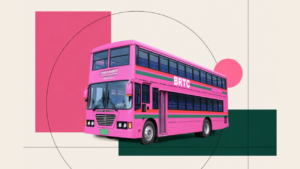

Dhaka: A new fleet of 14 women-only “Pink Buses” has begun operating in Dhaka as part of an effort to provide women with safer and more comfortable public transportation. However, the city’s previous experience with women-only bus services suggests that simply introducing dedicated buses may not be enough to solve the wider problems women face in public transport.
Women-only bus services are not a new concept in Dhaka. Bangladesh Road Transport Corporation (BRTC) first introduced women-only buses on four peak-hour routes in the early 1980s. The service stopped within days.
The initiative returned in July 2008 with five buses on a single route, but the service quickly became financially difficult to sustain. A planned expansion to 30 buses in 2009 did not take place because of shortages of buses and funding.
By 2010, BRTC had allocated around 22 buses for women. By 2022, only four remained in operation, while several others were reportedly left idle at depots. The women-only service was also suspended during the COVID-19 pandemic and did not fully resume.
Another version was introduced in 2014, with 17 buses operating on 13 routes during morning and evening peak hours. However, the service faced problems including low frequency and complaints that buses arrived late.
The private sector also attempted to provide dedicated services. In 2018, Rangs Group launched “Dolonchapa”, an air-conditioned women-only bus service equipped with CCTV, first-aid facilities and a tracking application. The project was initially planned to expand to 60 buses, but it started with only two and later became limited to a small number of trips on one route before being considered financially unprofitable.
These repeated attempts highlight three major challenges: limited numbers of buses, restricted operating hours and financial sustainability.
Dhaka operates thousands of buses across almost 100 routes, yet the city still faces a shortage of public transport.
Creating a separate women-only fleet does not automatically increase the total number of buses available to commuters. Instead, it divides an already limited transport capacity.
A dedicated bus may carry many passengers during peak hours but remain underused for much of the rest of the day. This creates a difficult financial model for operators because fuel, maintenance, staffing and other operating costs continue even when passenger numbers are low.
The problem becomes even more significant when a passenger has to wait specifically for a women-only bus instead of taking the next available general bus.
Data from Dhaka’s transport surveys shows that many women already experience relatively short waiting times for buses.
Around 52 percent of women surveyed reported waiting less than five minutes, while another 39 percent waited between five and ten minutes. This means roughly nine out of ten women were able to board a bus within ten minutes.
A small women-only fleet could potentially reduce this advantage if passengers have to wait specifically for a Pink Bus. If the dedicated bus arrives only after 20 or 30 minutes, many passengers may simply choose the next available general bus instead.
For working women, travel time matters. A transport service designed to improve safety should not unintentionally make daily commuting slower and less convenient.
The Dhaka Transport Coordination Authority (DTCA) conducted surveys under its Bus Route Rationalisation Project to understand passenger experiences.
One survey included 10,123 bus passengers, including 1,309 women. A separate office-commuter survey covered 962 working women.
The findings highlight how heavily women depend on public transportation. Around 96 percent of the women surveyed did not own a private vehicle. This makes the quality, reliability and safety of public transport particularly important.
Women rated their overall bus service satisfaction at only 2.35 out of 5. Safety received an average score of 2.32 out of 5.
Around 65 percent of women rated the overall service within the two dissatisfied categories, while approximately 63 percent gave similarly low ratings to safety.
Comfort, reliability, staff behaviour and bus-stop conditions also received relatively low scores.
The findings suggest that women are not facing a single isolated problem. They are dealing with a broader public transport system that performs poorly across multiple areas.
One of the most important findings is what women consider a priority when using public transport.
Women ranked travel time as the most important factor, with a score of 4.23 out of 5.
Safety followed with 4.15, while comfort scored 4.12.
This indicates that women want public transport to be safe, but they also need it to be frequent, reliable and efficient. A transport service that is safe but difficult to access or requires long waiting times may not meet their everyday needs.
The need for safer transportation should not be underestimated.
Multiple studies have documented harassment and safety concerns faced by women on public transport in Dhaka. The DTCA survey also shows that women’s satisfaction with transport safety remains very low.
Therefore, the question is not whether Dhaka needs safer transportation for women. It clearly does.
The bigger question is whether a small fleet of dedicated buses operating on limited routes can address a problem affecting millions of daily commuters.
Women appear willing to pay for better transportation, but their ability to pay significantly higher fares is limited.
Around 92 percent of surveyed women were satisfied with existing fare levels. At the same time, approximately 47 percent said they would be willing to pay more for genuinely improved services, particularly if they received better comfort and quality.
However, among working women considering a premium secure service, 64 percent were willing to spend less than Tk 2,000 per month, while only around 3 percent were willing to spend more than Tk 4,000.
This creates another challenge for a dedicated women-only service: operating costs can be higher, while passengers may have limited ability to absorb substantially higher fares.
The survey nevertheless shows strong demand for safer and more reliable transportation.
Around 70 percent of surveyed women said they would use a hypothetical premium service equipped with facilities such as CCTV, GPS and fingerprint-based access.
This suggests that women are not necessarily asking for cheaper transportation alone. They are looking for a service that combines safety, reliability, comfort and reasonable pricing.
Women-only buses can provide a useful option, particularly on routes where demand is strong. However, improving the overall public transportation system may have a much wider impact.
Measures could include:
The goal should not be simply to create a separate transport system for women. Instead, Dhaka needs a public transport network where women can travel safely and reliably regardless of which bus they use.
The 14 Pink Buses are now operating in Dhaka. Their long-term success will depend on whether the new initiative can overcome the problems that affected previous women-only services.
The key challenges will be bus availability, route coverage, service frequency, passenger demand and financial sustainability.
The experience of previous initiatives shows that launching a dedicated service is only the first step. For the Pink Bus initiative to become a lasting solution, it will need to respond to what women themselves say they need: safety, comfort, reliability, affordability and shorter waiting times.
Ultimately, improving the entire public transport network may be more difficult and less visible than introducing a fleet of brightly coloured buses, but it could benefit a far larger number of women across Dhaka.
Source: Dhaka Transport Coordination Authority (DTCA) Bus Route Rationalisation Project surveys and related research. The source material includes a User Satisfaction Survey of 1,309 women bus passengers and an Office Commuter Survey of 962 working women.