

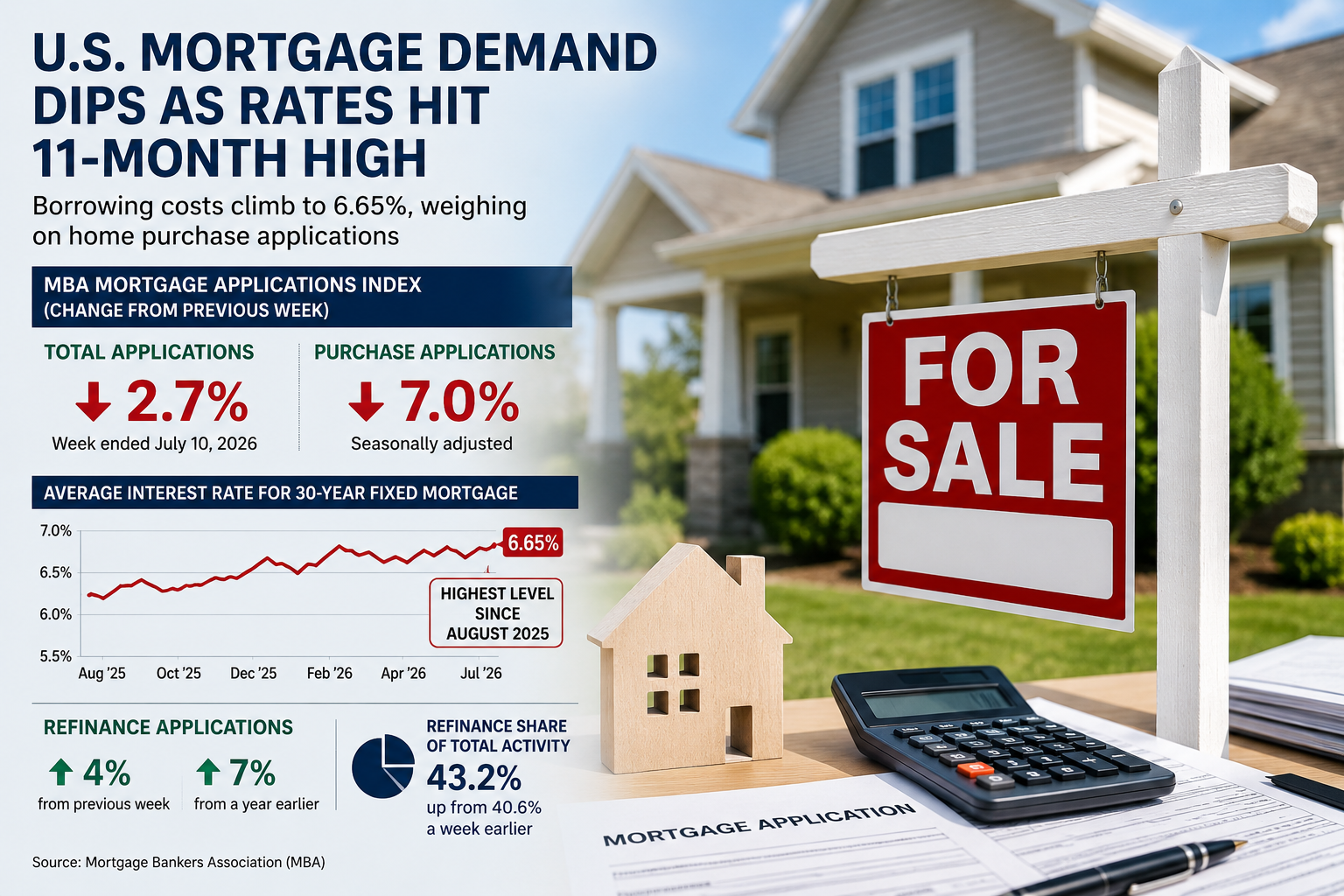
U.S. mortgage demand weakened last week as borrowing costs climbed to their highest level in nearly a year, highlighting the ongoing affordability challenges facing homebuyers despite the peak summer home-selling season.
According to the latest Mortgage Bankers Association (MBA) survey, total mortgage applications fell by 2.7% during the week ending July 10, 2026, compared with the previous week. The decline came after the Independence Day holiday period and was primarily driven by reduced demand for home purchase loans.
The average interest rate for a 30-year fixed-rate mortgage rose to 6.65%, its highest level since August 2025. The increase in financing costs discouraged many prospective buyers, with purchase mortgage applications dropping 7% from the previous week on a seasonally adjusted basis. Demand also slipped below the level recorded during the same period last year, reflecting continued pressure on housing affordability.
“Affordability remains the biggest challenge for prospective homebuyers,” said Joel Kan, Vice President and Deputy Chief Economist at the Mortgage Bankers Association. He noted that higher mortgage rates, combined with economic uncertainty, continue to reduce buyer activity even as more homes become available on the market.
In contrast, refinancing activity showed modest improvement. Applications to refinance existing mortgages increased 4% from the previous week and were 7% higher than a year earlier. The growth was largely supported by government-backed loan programs, including FHA and VA mortgages, as some homeowners sought opportunities to improve their loan terms.
Refinancing accounted for 43.2% of total mortgage applications, up from 40.6% a week earlier, indicating that refinancing is making up a larger share of mortgage market activity while home purchase demand remains subdued.
Interest rates also increased for several other loan categories, including jumbo mortgages and 15-year fixed-rate loans. However, adjustable-rate mortgages recorded a slight decline in borrowing costs, offering limited relief to some borrowers.
Housing market analysts expect mortgage demand to remain highly sensitive to interest rate movements in the coming months. Although inflation has eased compared with previous years, elevated Treasury yields continue to keep mortgage rates high, making homeownership less affordable for first-time buyers and discouraging existing homeowners from selling properties tied to lower-rate mortgages.
Economists believe that unless borrowing costs decline significantly, the U.S. housing market is likely to experience slower sales activity throughout the remainder of the summer season.